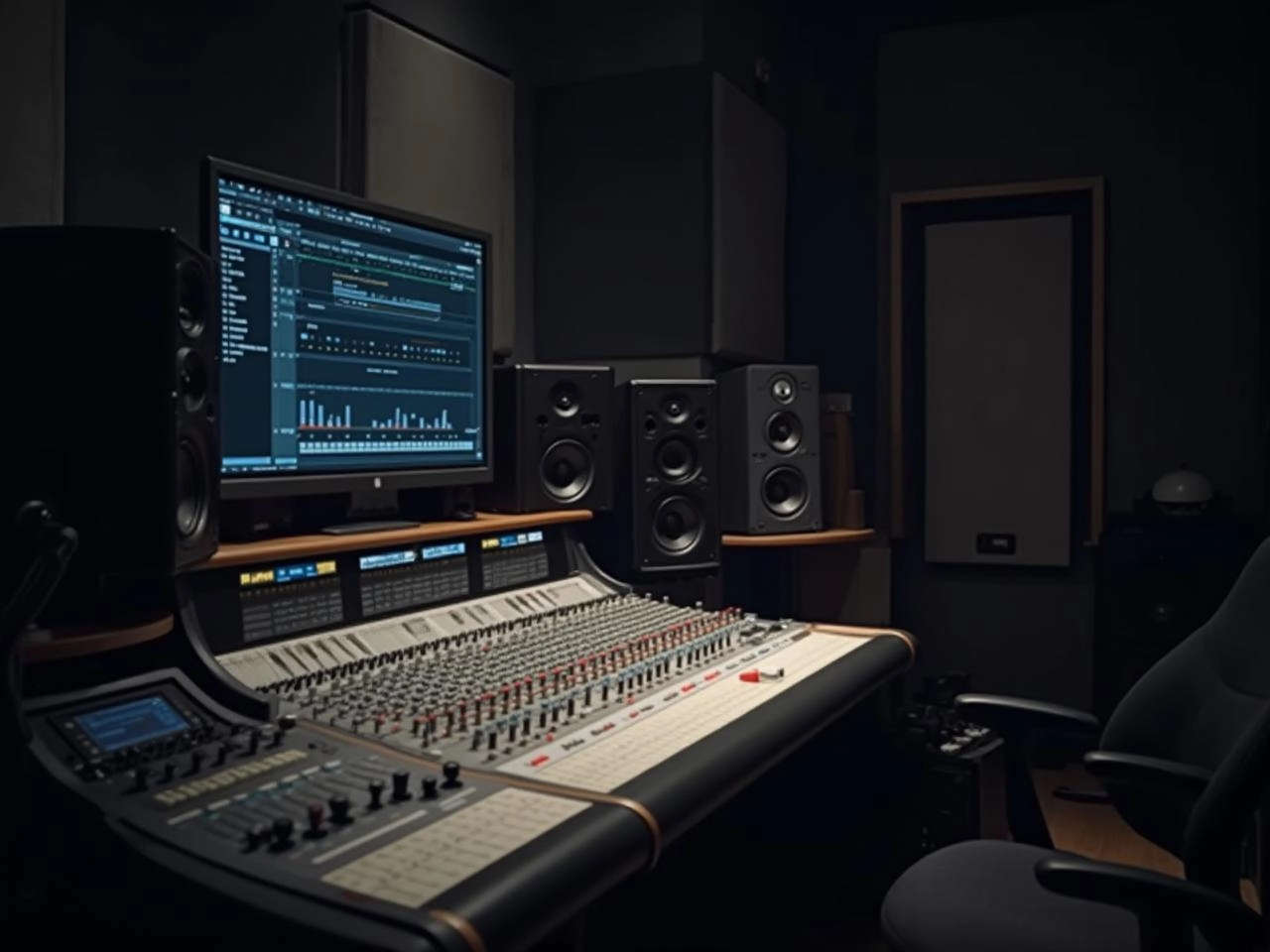
In professional recording studios, isolation solutions are not just an upgrade; they are a fundamental acoustic calibration tool used to ensure that monitor speakers provide an uncolored, acoustically transparent representation of the mix. Artists and producers use isolation mats and footers to completely decouple their near-field monitors from the console or desk, eliminating secondary desk resonance and achieving the critically needed flat frequency response required for objective, E-E-A-T-level audio mixing and mastering.
The Critical Need for Accurate Monitoring
A studio monitor’s job is to reproduce sound exactly as recorded, but vibrations compromise this fidelity:
- Desk Resonance: When a speaker sits directly on a console or desk, the desk itself acts as a massive, secondary sound radiator. This introduces false low-frequency energy (a “bass bump”) that is not present in the original mix.
- The Translation Problem: If the producer mixes the bass based on this false desk resonance, the final track will sound weak and bass-shy when played on other systems (cars, headphones). This is known as the “translation problem.”
- Microphonic Effect: Sensitive studio equipment, especially tube preamps and microphones, can pick up mechanical vibrations from the environment, introducing unwanted noise into the pristine recording chain.
Isolation Mat Placement in the Studio Workflow
Professional isolation products are strategically deployed across the recording and mixing chain:
- Under Near-Field Monitors: The most common application. Isolation mats made of high-damping composites (like microcell rigid foam) are used to eliminate the structural coupling between the monitor cabinet and the mixing console. This provides an immediate improvement in mid-range clarity and low-end transient response.
- Under Subwoofers: Studio subs generate the most destructive low-frequency energy. They are placed on large, thick isolation foundations to prevent the energy from traveling through the floor and vibrating control room elements (like lighting, ceiling panels, or mic stands).
- Under Sensitive Equipment: Preamplifiers, analog compressors, and Digital-to-Analog Converters (DACs) are often placed on small isolation footers to protect their delicate internal circuitry from floor or console vibrations, ensuring signal purity.
Achieving a Flat Frequency Response
The goal of isolation in a studio is to create a true anechoic base for the monitor. The isolation mat removes the desk/surface from the acoustic equation.
- Before Isolation: The frequency response graph shows a major spike (e.g., +6 dB) in the 80-120 Hz range due to desk resonance.
- After Isolation: The mat dampens this resonance, and the frequency response flattens out, allowing the engineer to hear the actual output of the speaker and make unbiased mixing decisions.
Q&A: Pro Studio Techniques
Q: Do isolation mats replace acoustic foam in a studio? A: No. They are complementary. Isolation mats handle structure-borne vibration (physical transmission), while acoustic foam/panels handle air-borne sound (echo, reflections, standing waves). Both are essential for a professional setup.
Q: Why do producers use specialized footers under rack gear? A: Rack gear (especially power supplies and analog components) generates internal hum. Footers are used to isolate the individual component from the metal rack chassis, which itself can act as a massive conduit for vibration, ensuring a quieter recording signal.